

Aim and Scope of the project
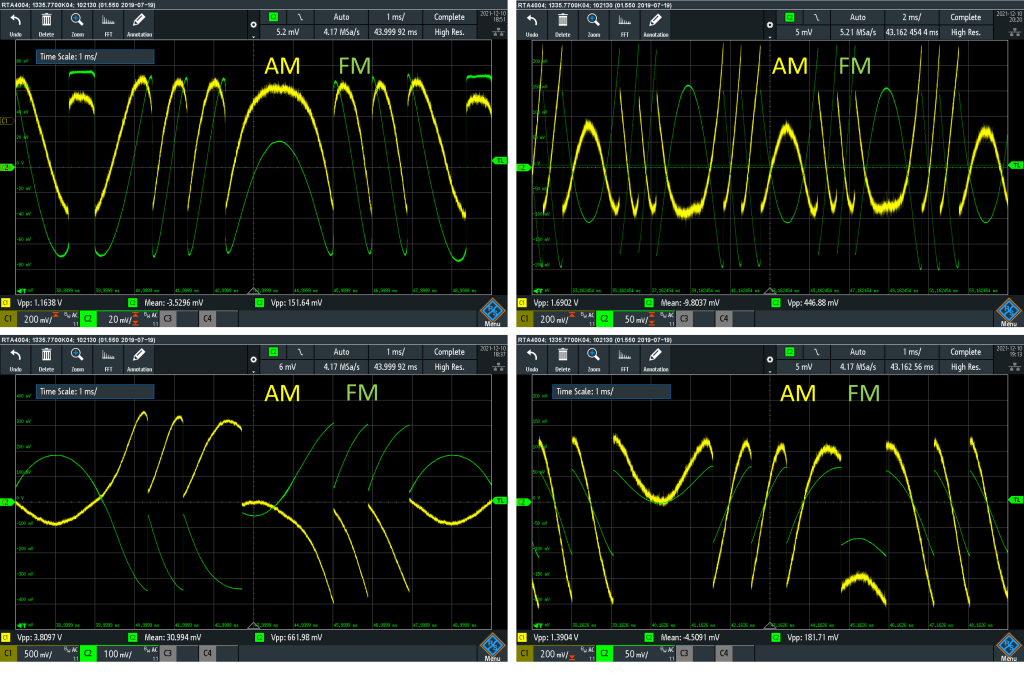
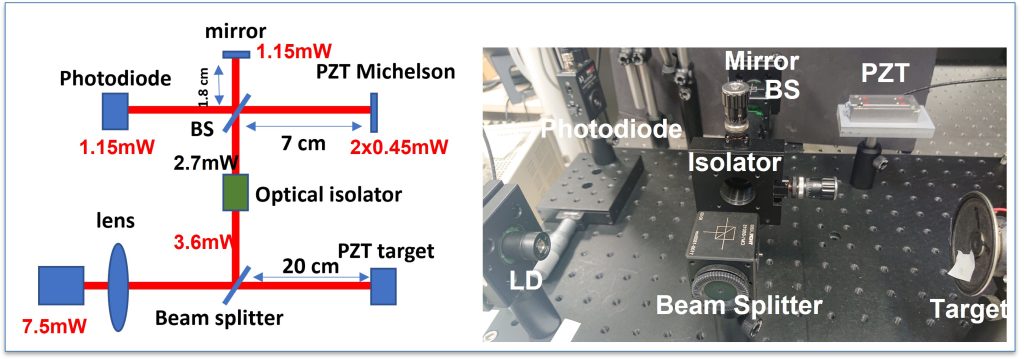
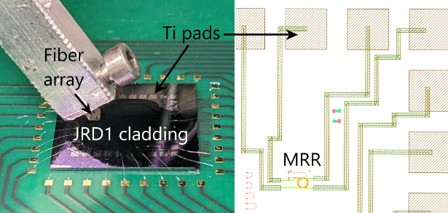
PICSONDE focuses on designing and fabricating an embedded sensing system based on optical feedback interferometry (OFI) in a laser diode, thus integrating the light source, the interferometer, and the photodetector within the same package. This proposed OFI-based sensor combines a photonic integrated circuit (PIC) that allows to retrieve the frequency modulated (FM) channel of the OFI signal, with a system-on-chip (SoC) for both data acquisition and signal processing. The sensor resolution targets the OFI quantum limited performance of 0.1 pm/√Hz noise power spectrum density over a large bandwidth (up to 100 kHz) for real-time experimental modal analysis applied to predictive maintenance applications in particular.
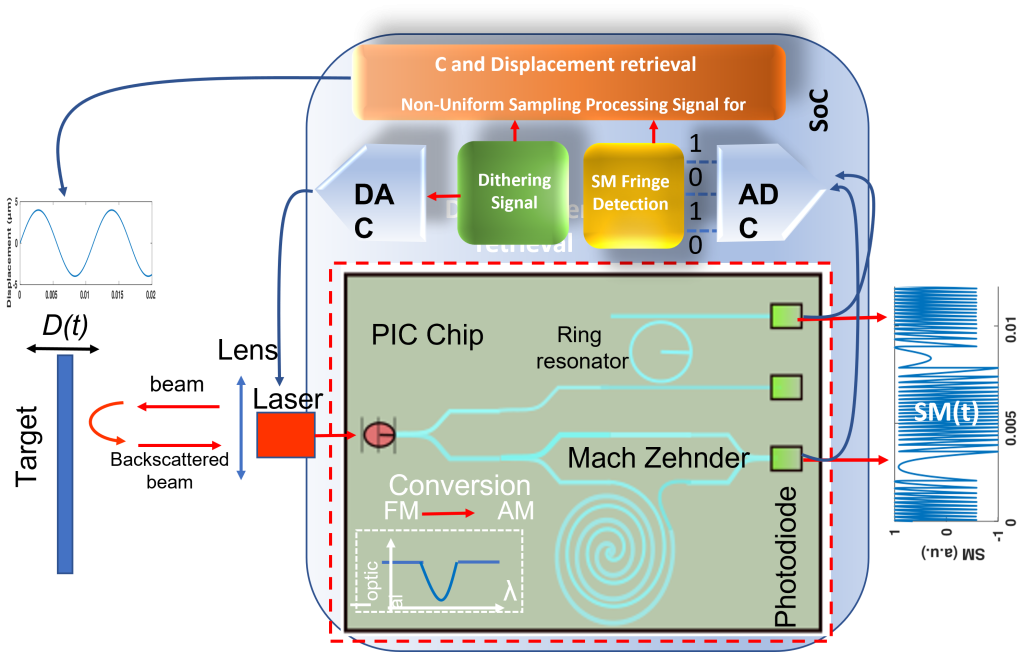
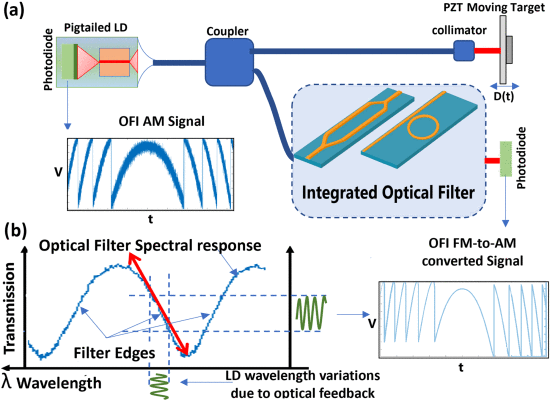
This performance is three orders of magnitude better than existing OFI systems that process the optical output power modulated by OFI, also referred to as the amplitude modulated (AM) channel. For this purpose, four main technological barriers should be resolved: (1) acquire RIO signals with both the highest dynamic range and signal to noise ratio, (2) retrieve the information embedded within highly non-linear RIO signals, (3) assess in real-time the optical feedback factor between the laser and the target, and (4) detect the interferometric fringes in the presence of speckle. To achieve the target resolution, it is required to exploit the FM channel of OFI signals instead of the AM channel to benefit from greatly enhanced noise performances since the OFI signal is no longer limited by the laser shot noise but by its linewidth. The inherent compactness of the PIC will also enhance the system robustness for operation in an industrial environment. In addition, we propose to assimilate the OFI signals to an inherent non-uniform sampling system to be directly processed by an SoC. The laser thus becomes both the sensor and the non-uniform optical data acquisition system.
By combining the laser with the PIC and the signal processing SoC, a sensor prototype will be fabricated, and in situ tests will be carried out in collaboration with an industrial end user for predictive maintenance. Nevertheless, this compact high-resolution interferometric sensor can also be used to measure refractive index variations that correspond to optical path changes. Additionally, the sensor can, via the PIC, potentially be exploited to optically probe MEMS structures. This opens a pathway to develop high-resolution (bio)chemical refractometric sensors and optically integrated MEMs sensors.
CONSORTIUM
LAAS-CNRS
BERNAL Olivier (Ass. Prof): Coordinator
BOSC Thierry (Prof.)
JAYAT Francis (Research Eng.)
SEAT Han Cheng (Associate Prof)
TAP Hélène (Prof)
TRONCHE Clément (Research Eng.)
LAUM-ESEO
FEUILLOY Mathieu (Ass. Prof): Partner’s scientific leader
PLANTIER Guy (Prof.)
GLASGOW University
SURRE Frédéric (Ass. Prof.)
ACOEM
MAZOYER Thierry
Publications
JOURNALS
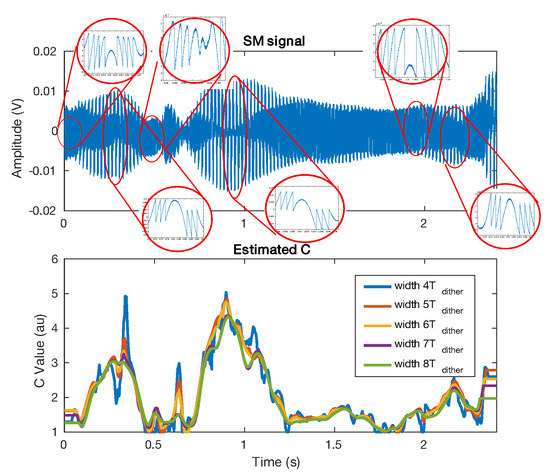
- Bernal, O.D.; Zabit, U.; Jayat, F.; Bosch, T. Toward an Estimation of the Optical Feedback Factor C on the Fly for Displacement Sensing. Sensors 2021, 21, 3528. https://doi.org/10.3390/s21103528
- Siddiqui, A. A., Zabit, U., & Bernal, O. D. (2022). Fringe Detection and Displacement Sensing for Variable Optical Feedback-Based Self-Mixing Interferometry by Using Deep Neural Networks. Sensors, 22(24), 9831. https://doi.org/10.3390/s22249831
- S. S. Khurshid, W. Hussain, U. Zabit and O. D. Bernal, « Augmentation assisted robust fringe detection on unseen experimental signals applied to optical feedback interferometry using a deep network, » in IEEE Transactions on Instrumentation and Measurement 2023, https://doi.org/10.1109/TIM.2023.3251409
- H. S. Bazaz, M. M. Fatimah, L. Asim, U. Zabit and O. D. Bernal, « Integration of Zero Crossing Method in a Non-Uniform Sampling System using Optical Feedback Interferometry, » in IEEE Sensors Journal, doi: 10.1109/JSEN.2023.3275702.
- O.D. Bernal, H.C. Seat, U. Zabit and F. Surre, « Direct Estimation of the Optical Feedback Factor C From the Amplitude of the Optical Feedback Interferometric Signal », in IEEE Transactions on Instrumentation and Measurement 2023, 10.1109/TIM.2023.3300431
- C. Deleau et al., « Optical Feedback FM-to-AM Conversion With Photonic Integrated Circuits for Displacement Sensing Applications, » in Journal of Lightwave Technology, doi: 10.1109/JLT.2024.3355048
- Arshad, Ayesha, et al. « Robust integrated optical feedback interferometry via variable optical attenuation. » Optics Express 33.8 (2025): 17566-17579.DOI: https://dx.doi.org/10.1364/OE.550127
- Muslim, Syed Muhammad, Olivier D. Bernal, and Usman Zabit. « Efficient Computation of Laser Self-Mixing Sensor Signal under Variable Optical Feedback. » IEEE Sensors Journal (2025). DOI: https://dx.doi.org/10.1109/JSEN.2025.3581469
- Siddiqui, Asra Abid, et al. « Estimation of variable optical feedback coupling factor for self-mixing interferometry by signal-to-image translation. » Applied optics 64.26 (2025): 7788-7798. DOI: https://doi.org/10.1364/AO.567935
- Mathieu Feuilloy, Guy Plantier, Francis Jayat, Olivier Bernal. “Neural Network-Based Estimation of Optical Feedback Factor in Self-Mixing Interferometry Systems across various feedback regimes”. IEEE Transactions on Instrumentation and Measurement, 2025, 74, doi: 10.1109/TIM.2025.3580871.
- Clement, D., Seat, H. C., Bernal, O., & Frederic, S. (2026). Electro-thermo-optical modulation of silicon nitride integrated photonic filters for analog applications. Photonics, 13(2), 149. doi:https://doi.org/10.3390/photonics13020149
CONFERENCES
- C. Deleau, T. Apiphatnaphakul, H. C. Seat, F. Surre, U. Zabit, F. Carcenac, P.-F. Calmon, T. Bosch, O. Bernal, “Towards Integrated Optical Feedback FM-to-AM Conversion in Silicon Nitride for Displacement Sensing Applications”. IEEE Sensors 2022 Conference (30 oct – 2 nov 2022). https://doi.org/10.1109/SENSORS52175.2022.9967153
- O. Bernal, H. C. Seat, F. Surre, U. Zabit, C. Deleau, T. Bosch, “Non-Uniform Sampling Theory applied to FM Channel Optical Feedback Interferometry for Displacement Sensors”. IEEE Sensors 2022 Conference (30 oct – 2 nov 2022). https://doi.org/10.1109/SENSORS52175.2022.9967106
- C. Deleau, H. C. Seat, F. Surre, U. Zabit, P.-F. Calmon, O Bernal, « Optical Feedback FM-to-AM Conversion with integrated Micro-Ring Resonator for Displacement Sensing Applications », AIVELA 15th conference 2023 (21-23 june 2023) Ancona.
DATASETS
- O. Bernal, H. C. Seat, F. Surre, U. Zabit, « Estimation of the Optical Feedback Factor C », 2023 https://doi.org/10.5281/zenodo.7737315
GALLERY
-
Résidence Art & Science via l’ANR CONNECT-2 et l’ANR PICSONDE
Artiste photographe: Sara Bensaltana
Lieu : Quai des savoirs Toulouse
Lien : https://quaidessavoirs.toulouse-metropole.fr/2025/04/03/faire-de-la-photographie-vivante-sara-bensaltana/Mini Expo en ligne sur Explorateur: https://exploreur.univ-toulouse.fr/la-recherche-de-linvisible
Mini Expo en ligne sur le compte Instagram de l’Explorateur: « À la recherche de l’invisible »
Résidence Art & Science via l’ANR CONNECT-2 et l’ANR PICSONDE
Artiste photographe: Sara Bensaltana
Lieu : Quai des savoirs Toulouse
Lien : https://quaidessavoirs.toulouse-metropole.fr/2025/04/03/faire-de-la-photographie-vivante-sara-bensaltana/